
The Complete Guide to Immersive Home Buying: Virtual Tours, Showrooms & Smart Decisions
Immersive Home Buying is a decision-centric real estate framework that uses 3D virtual tours, augmented reality visualizations, and physical Smart Showrooms to guide buyers from exploration to a move-in-ready home. By digitizing discovery and validating decisions in person, this process reduces uncertainty, shortens sales cycles to under 90 days, and delivers full pricing transparency before construction begins.
In 2026, home buying isn’t broken because prices are high—it’s broken because decisions are made with incomplete information.
Buyers are expected to commit hundreds of thousands of dollars based on static photos, rushed showings, and competitive pressure. In markets like Kenosha, Wisconsin—the #1 hottest housing market in the U.S.—that pressure creates anxiety, regret, and missed opportunities.
Immersive Home Buying exists to solve that.
The failure of passive browsing: why traditional home buying is broken
Scrolling listings and driving past homes used to work—when inventory was abundant and timelines were forgiving.
Today, static photos create what we call the visualization gap: the disconnect between what a home looks like online and how it actually lives day to day.
In 2026, more than 40% of housing decisions are made before a buyer’s first physical visit. If a buyer can’t clearly understand layout, flow, and functionality early, they either hesitate—or overcommit.
In Kenosha’s ultra-competitive market, that leads to rushed bids, buyer’s remorse, and settling for homes that don’t truly fit.
Phase 1: virtual discovery (the remote walkthrough)
Immersive buying begins with virtual discovery.
At Adrenaline Homes, this phase uses Matterport-powered 3D digital twins enhanced with realistic lighting and scale accuracy. Buyers don’t just view a home—they walk it.
This allows you to:
Understand spatial flow before visiting in person
Compare manufactured vs. modular floor plans efficiently
Identify layout issues early (kitchen bottlenecks, bedroom privacy, storage needs)
Test-fit furniture and lifestyle needs virtually
Buyers who complete a virtual tour are over 130% more likely to book a consultation, because confidence replaces guesswork.
(If you’re new to this technology, start with our guide on Virtual Home Tours.)
Phase 2: the Kenosha showroom (physical validation)
In the hottest housing market in America, digital confidence still needs physical proof.
That’s where the Kenosha Smart Showroom becomes essential.
Here, virtual exploration meets real-world validation:
VR headsets bring floor plans to life at full scale
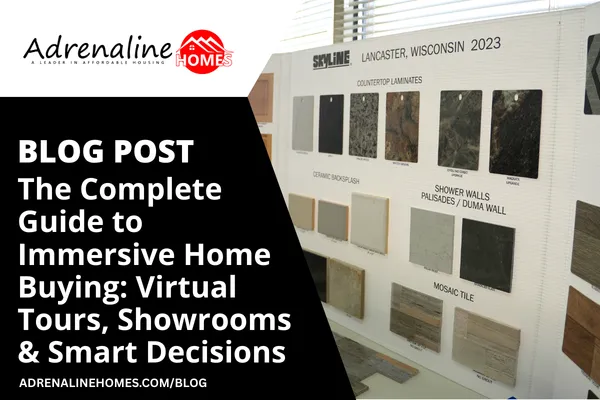
Physical samples let you touch cabinetry, countertops, siding, and finishes
Specialists translate digital choices into permitting-ready decisions
This is the moment the process moves from pixels to permits.
Instead of wondering if materials feel “right,” buyers confirm it—before ordering.
The financials: the equity acceleration formula
Immersive buying isn’t just about confidence—it’s about leverage.
By shortening timelines and avoiding bidding wars, buyers gain what we call equity acceleration.
Where:
$V_{market}$ = Current market value of comparable site-built homes in Kenosha
$C_{manufactured}$ = Total cost of your Adrenaline Home
$M_{savings}$ = Monthly savings vs. renting or traditional construction
$T_{months}$ = Time saved through the 90-day move-in process
In a locked-in market where sellers aren’t listing, building strategically can outperform waiting.
Making the smart decision: a four-point framework
Immersive Home Buying replaces emotion-driven decisions with structured clarity.
Use this checklist before committing:
Spatial Flow
Does the 3D tour reveal natural movement—or daily friction?
Material Integrity
Have you physically verified finishes, durability, and build quality?
Local Zoning Alignment
Does your plan match Southeastern Wisconsin land and foundation requirements?
Energy Resilience
Is your home built to meet 2026 efficiency and cost-of-ownership standards?
If all four align, confidence follows.
The decision matrix: traditional vs immersive buying
Rather than forcing buyers to mentally compare dozens of details, immersive home buying simplifies the decision by changing how information is experienced.
Discovery
Traditional home buying relies on 2D photos and quick drive-bys, which hide spatial flow and scale. Immersive buying uses 3D Matterport tours and VR walkthroughs so buyers understand a home before ever stepping inside.
Customization
The old approach depends on imagination and rough samples. Immersive buying allows AR-style material swaps and digital configuration, letting buyers see finishes and layouts together before committing.
Trust factor
Static listings depend on seller disclosures and assumptions. Immersive buying is grounded in digital twin accuracy—what you see is what gets built.
Speed
Traditional construction often stretches 6–12 months or longer. Immersive buying compresses the timeline into a predictable 90-day move-in window.
Market reality
Instead of competing in bidding wars for limited inventory, immersive buyers create private inventory by ordering a home designed specifically for their needs.
Why immersive buying matters in Kenosha right now
Kenosha’s #1 ranking isn’t just a headline—it’s a constraint.
Homes here sell fast, competition is intense, and waiting for inventory to “cool” means falling behind. Realtor.com data shows properties moving in as little as 44 days.
Immersive Home Buying lets you bypass that scarcity by creating your own opportunity—without rushing or overpaying.
Instead of fighting the hottest market, you build within it.
Continue your immersive journey
This guide is the foundation—but each step matters.
Explore layouts through our Virtual Home Tours
Understand options in our Manufactured vs. Modular Guide
Validate everything at the Kenosha Showroom
In a market defined by speed and pressure, immersive buying gives you something rare: clarity before commitment.