
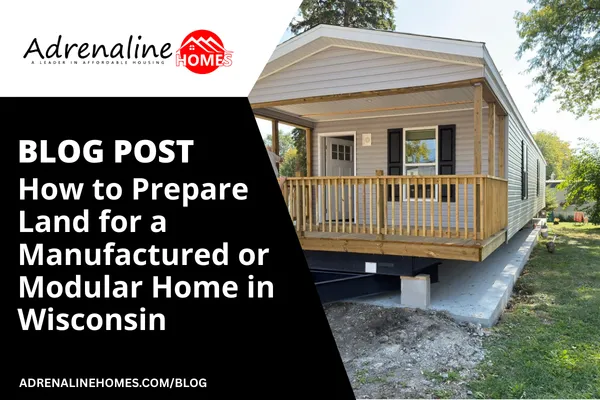
How to Prepare Land for a Manufactured or Modular Home in Wisconsin
Preparing land for a manufactured or modular home in Wisconsin typically involves verifying zoning, completing a soil or perc test, installing utilities, and building an approved foundation. Most buyers complete land preparation while their home is being built in the factory, allowing installation and move‑in to happen in roughly 90 days.
For many first‑time buyers, land preparation is the most intimidating part of buying a manufactured or modular home.
Questions like "Can I actually put a home on this property?" "What permits do I need?" and "How much will site prep cost?" are often the reasons buyers stop moving forward.
The good news: land preparation in Wisconsin follows a predictable process. Once you understand the steps—from zoning checks to utilities—you can confidently evaluate whether a property will work for your home.
This guide breaks down what buyers in Kenosha County, Racine County, and Southeast Wisconsin need to know.
Do you need land before buying a manufactured home?
Not always.
Most buyers fall into one of three categories:
1. You already own land
If you already own rural land or a residential lot, the first step is verifying zoning, utilities, and soil conditions.
2. You’re buying land at the same time as your home
Many buyers purchase land and their home simultaneously. This allows site preparation to happen while the home is being built in the factory.
3. You plan to place the home in a community
Some buyers choose a land‑lease community. In this case, most site preparation is already handled by the community owner.
Understanding which scenario you fall into determines the rest of the process.
Can you place a manufactured home on rural land in Wisconsin?
Often yes—but zoning determines everything.
Each county and municipality has zoning rules that control:
Minimum lot sizes
Setback requirements
Utility access
Whether manufactured homes are allowed
Many municipalities in Southeast Wisconsin follow the Wisconsin Uniform Dwelling Code (UDC) for modular homes and other permanent structures.
Manufactured homes may have additional placement rules depending on the township or county.
Before purchasing land, buyers should verify zoning through their local planning department or online mapping tools such as the Kenosha County Interactive Mapping System.
The Foundation Factor: Wisconsin SPS 321 Requirements
Wisconsin winters make foundations extremely important.
Under Wisconsin SPS 321, foundations must protect the structure from frost movement. In southern Wisconsin, the frost depth typically reaches about 48 inches.
Foundation requirements differ depending on the type of home:
Manufactured homes
Often installed on floating slabs or pier systems
Must include approved tie‑down anchoring systems
Can sometimes qualify for frost‑protected shallow foundations (FPSF)
Modular homes
Must meet the Wisconsin Uniform Dwelling Code
Typically require full perimeter foundations such as basements or crawlspaces
Because foundation systems vary with property conditions, a local contractor or engineer typically confirms the appropriate design during the permitting phase.
The Soil Test: Why a Perc Test Matters
If your land is outside a municipal sewer district, a perc test is required before building.
A percolation (perc) test measures how quickly soil absorbs water and determines which type of septic system can be installed.
In Wisconsin, this system is officially called a POWTS (Private Onsite Wastewater Treatment System).
Typical outcomes include:
Conventional gravity septic systems
Mound systems for slower‑draining soils
Holding tanks for difficult sites
In Kenosha and Racine counties, mound systems are common when soil drainage is limited.
This is important because system type can dramatically affect cost.
Typical Land Preparation Costs in Wisconsin
Land preparation costs vary widely depending on terrain, utilities, and soil conditions. However, the following ranges reflect common estimates for the Midwest in 2026.
Perc test or soil evaluation
Usually between $600 and $1,200, depending on terrain complexity.
Septic system (POWTS)
A conventional septic system may cost $8,000 to $15,000, while a mound system can cost $15,000 to $25,000.
Well drilling
Most wells in Southeast Wisconsin are drilled between 100 and 300 feet deep. Typical installation costs range from $10,000 to $18,000.
Excavation and driveway installation
Clearing land, grading, and installing driveway access generally ranges from $5,000 to $12,000, depending on distance and tree removal.
Electrical connection
Hooking up electricity may cost $2,500 to $6,000, depending on the distance from the nearest utility pole.
While these numbers vary by property, understanding them early helps buyers plan realistic budgets.
Rural Property Challenge: Culvert Installation
One surprise many rural buyers encounter in Kenosha County is the requirement to install a culvert when creating driveway access.
Culverts allow water to flow beneath driveways and are often required before a building permit can be issued.
The county typically specifies:
Culvert diameter
Pipe material
Placement location
Because requirements vary by township, verifying this early can prevent delays.
Who pulls the permits: You or the builder?
One of the most common questions buyers ask is who handles permits.
The answer depends on the builder and the municipality.
Some builders require buyers to coordinate permits themselves, which can involve multiple offices including zoning, sanitation, and utilities.
Other builders—like Adrenaline Homes—guide buyers through the entire process. This often includes helping coordinate:
Zoning approvals
Foundation permits
POWTS septic permits
Electrical and utility connections
Having a team that understands local requirements in Kenosha, Racine, and surrounding counties can significantly reduce delays.
The Hidden Cost Many Buyers Miss: Impact Fees
Some Wisconsin municipalities charge impact fees for new construction.
These fees help fund infrastructure such as roads, schools, and utilities.
Impact fees vary widely by municipality, and buyers often discover them late in the process.
Checking with the local planning office before purchasing land helps prevent surprises.
Land Readiness Checklist: 5 Signs Your Land Is Ready
Before committing to a property, look for these signals:
Zoning allows manufactured or modular homes
The property passes a soil or perc test
Utilities are accessible nearby
The site has adequate driveway access
Local permits are achievable without major restrictions
If these conditions are met, your land is likely ready for development.
How Land Preparation Fits the 90‑Day Move‑In Timeline
One advantage of manufactured and modular construction is that land preparation happens at the same time the home is being built in the factory.
While the home is under construction:
Foundations are installed
Utilities are connected
Driveways and grading are completed
By the time the home arrives on site, the property is ready for installation.
Final Takeaway: Land Preparation Is Easier Than Most Buyers Expect
For many buyers, land preparation feels complicated simply because the process is unfamiliar.
In reality, once zoning, soil testing, utilities, and foundation planning are confirmed, the remaining steps follow a predictable path.
Understanding these requirements early helps buyers avoid surprises—and move confidently toward homeownership.
If you're considering land in Kenosha, Racine, or Southeast Wisconsin, our team can help evaluate whether a property is suitable for a manufactured or modular home before you purchase it.