
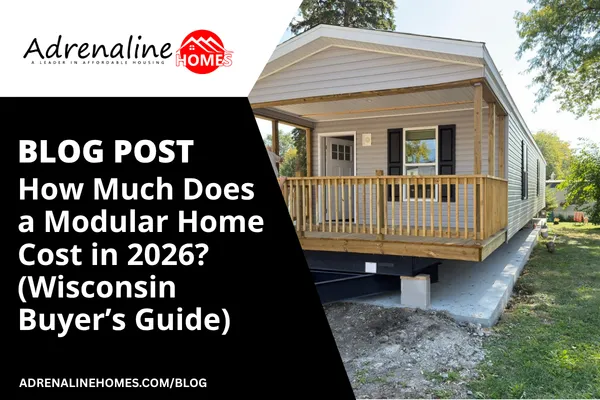
How Much Does a Modular Home Cost in 2026? (Wisconsin Buyer’s Guide)
In 2026, a modular home in Wisconsin typically costs between $120,000 and $350,000, depending on size, finishes, and site preparation. A modular home is a residence built in a climate-controlled factory setting in sections (or modules), which are then transported to a permanent site and assembled on a foundation. Unlike manufactured homes, modular homes are built to the same local and state building codes as traditional site-built houses, making them eligible for conventional mortgages and standard home appraisals.
For Wisconsin buyers, that’s a significant advantage. As of January 2026, the median price for an existing single-family home in Wisconsin reached $315,000—a 7.9% increase year over year. Modular construction offers a new-build experience at a price point that’s often $50,000 to $80,000 lower than comparable stick-built inventory, without sacrificing quality, energy efficiency, or long-term value.
Whether you’re a first-time buyer, looking to build on family land, or exploring affordable new construction, this guide breaks down every cost you need to plan for—from the base modules to the final utility hookup.
Average Modular Home Cost in 2026 — National vs. Wisconsin
Nationally, a turnkey modular home in 2026 costs approximately $150 to $250 per square foot, fully installed. That range includes the base modules, delivery, foundation, and standard site work—though premium finishes, complex foundations, and rural utility runs can push costs higher.
Wisconsin buyers have a notable advantage. Prices in the state currently trend 10–15% lower than the national average, thanks to regional manufacturing efficiencies, competitive labor markets, and lower land costs in many counties outside of the Milwaukee metro area.
To put that in context: a 1,500-square-foot modular home that might cost $300,000 turnkey in a higher-cost state could come in closer to $250,000–$270,000 in much of Wisconsin. And compared to the state’s $315,000 median existing home price, you’re getting brand-new construction—built to current energy codes, with modern finishes—for less than what many buyers are paying for 20- or 30-year-old inventory.
Cost Breakdown by Size
Modular home pricing scales with square footage, but it’s not perfectly linear—larger homes benefit from economies of scale on shared systems like HVAC, plumbing, and electrical. Here’s how pricing breaks down across the most common size categories, with real models from the Adrenaline Homes lineup as reference points.
Small / ADU (500–600 sq ft): $120,000 – $165,000
At this size, you’re looking at 1–2 bedrooms and 1 bathroom—ideal for an accessory dwelling unit, in-law suite, or starter home. The In-Law model by Adrenaline Homes at 540 square feet with 2 bedrooms and 1 bath is a perfect example. These compact units deliver a surprisingly livable floor plan and are increasingly popular with Wisconsin homeowners adding rental income or multigenerational living space to their property.
Mid-Range Entry (1,000–1,100 sq ft): $165,000 – $210,000
This is where most first-time buyers land. A 3-bedroom, 2-bathroom home with a full kitchen, open living area, and enough space for a growing family. The Tesla model at 1,012 square feet is Adrenaline Homes’ entry point in this range—it comes standard with stainless steel appliances, shaker-style cabinetry, recessed LED lighting, and energy-efficient Low-E vinyl windows. At this price point, you’re getting a brand-new home for significantly less than Wisconsin’s median existing home price.
Mid-Range Family (1,400–1,600 sq ft): $210,000 – $295,000
The sweet spot for families. Three bedrooms, two full bathrooms, and enough square footage for dedicated dining areas, larger kitchens, and comfortable living spaces. Adrenaline Homes offers several models in this range: the Aberdeen (1,512 sq ft), the Skyliner (1,378 sq ft), the Citation (1,577 sq ft), and the Essence 3 (1,600 sq ft). These double-wide models feature R-29 roof insulation, gas furnaces, and the kind of interior finishes—crown molding, furniture-style vanities, textured ceilings—that rival site-built homes at a fraction of the cost.
Premium (1,600–1,800+ sq ft): $295,000 – $420,000+
At the top of the lineup, you’re getting 3–4 bedrooms, 2+ bathrooms, and premium construction specs. The Royale model at 1,805 square feet comes standard with 2x6 exterior walls, R-49 roof insulation, a high-efficiency Trane® gas furnace, argon-filled Low-E windows with grids, and hardwood shaker cabinetry with dovetail drawer construction. The Lexington at 1,685 square feet offers a similar premium experience. These homes are built to perform in Wisconsin winters and appraise identically to site-built construction.
Note: All turnkey price estimates above include base modules, delivery, standard foundation, and basic site hookups. Final pricing varies by land condition, foundation type, and selected upgrades. Contact Adrenaline Homes for a personalized quote.
What’s Included vs. What Costs Extra
One of the most common questions we hear is, “What does that price actually get me?” Here’s the breakdown.
What’s Typically Included
Your base modular home price covers the complete structure: all framing, insulation rated for Wisconsin’s climate (R-29 roof insulation is standard on most Adrenaline Homes models), roofing with 25-year shingle warranties, and vinyl lap siding. Inside, you get standard cabinetry, vinyl and carpet flooring, a kitchen appliance package (typically stainless steel refrigerator and gas range), plumbing fixtures, rough-in electrical and plumbing, and in many 2026 models, smart-home wiring frameworks—a feature that would cost around $2,500 as an add-on in a site-built home.
The “Hidden” Costs to Budget For
Beyond the home itself, there are several additional costs that catch first-time modular buyers off guard. Plan for these from the start:
Land: $30,000–$100,000+ depending on location. Southeast Wisconsin (Kenosha, Racine, Milwaukee counties) commands higher prices, while rural lots farther north or west can be significantly more affordable.
Site preparation and foundation: $15,000–$45,000. This is the big variable. A simple concrete slab runs on the lower end, while a full basement—common in Wisconsin for both storage and tornado safety—pushes toward the higher end. Heavily wooded lots or sites that need grading add cost as well. (For a deeper dive, see our guide: How to Prepare Land for a Manufactured or Modular Home in Wisconsin.)
Permits: $1,500–$5,000, varying by municipality.
Utility hookups: $5,000–$15,000. Municipal water and sewer tap-ins are on the lower end; private well and septic system installations cost more.
What Is the Most Expensive Part of Building a Modular Home?
Aside from the base modules themselves, the site preparation and foundation are the most expensive components, typically accounting for 20% to 25% of the total project budget. In Wisconsin, digging a full basement or clearing heavily wooded lots can significantly impact this cost. That’s why choosing your lot carefully—and getting a site evaluation early in the process—can save you thousands.
Manufactured vs. Modular Pricing — What’s the Difference?
Both manufactured and modular homes are factory-built, but the similarities in pricing end there. Understanding the distinction matters because it directly affects your financing options, long-term value, and total cost of ownership.
Manufactured homes are built to the federal HUD code and are typically 15–20% cheaper than modular homes upfront. However, if a manufactured home isn’t placed on a permanent foundation on land you own, it’s classified as personal property rather than real estate. That means you’ll likely need a chattel loan, which typically carries higher interest rates and shorter terms than a conventional mortgage. (For a full breakdown of financing options, check out our Complete Guide to Manufactured Home Financing in Wisconsin.)
Modular homes are built to Wisconsin’s Uniform Dwelling Code (UDC)—the same code as site-built houses. They’re placed on permanent foundations and appraised identically to traditional construction. That means you qualify for a conventional 30-year mortgage with standard rates, and your home appreciates in line with the local real estate market.
The bottom line: manufactured homes cost less upfront but may cost more over the life of the loan. Modular homes cost more initially but offer better financing terms and stronger long-term equity. For a detailed comparison of the two, see our post: Manufactured vs Modular Homes: What Actually Matters When Choosing.
Are Modular Homes Cheaper Than Site-Built Homes?
Yes. In 2026, modular homes are typically 15% to 25% cheaper than comparable site-built homes. The savings come from bulk material purchasing (which cuts material costs by roughly 20%), controlled factory environments that reduce construction waste by up to 90%, and faster build timelines that reduce labor overhead. On average, a Wisconsin buyer saves $60,000 to $90,000 by choosing modular over traditional stick-built construction—while getting a home built to the exact same code.
How to Finance a Modular Home in Wisconsin
Because modular homes are classified as real property, you have access to the full range of mortgage products—the same ones available for any site-built house. Here are the most common options for Wisconsin buyers:
Conventional mortgage: Requires a 620+ credit score and a 5% down payment. This is the most common route for buyers with good credit and some savings.
FHA One-Time Close: Requires a 580+ credit score and just 3.5% down. This loan combines the construction phase and permanent mortgage into a single closing, which saves on fees and simplifies the process. It’s ideal for first-time buyers.
USDA loan: $0 down payment for eligible rural Wisconsin areas (typically requires a 640+ credit score). Many towns outside of Kenosha, Racine, and Milwaukee metro areas qualify.
VA loan: $0 down payment for veterans and active-duty military. One of the most powerful financing tools available, and it works for modular construction just like it does for any other home.
Kenosha market note: With Kenosha ranked as one of the hottest housing markets in 2026, modular financing has become an increasingly popular path for buyers who are tired of losing bidding wars on existing homes. Building new means no competing offers, no waived inspections, and a home built exactly to your specifications.
Frequently Asked Questions
How much does a modular home cost per square foot?
Base modular units (the structure alone, before site work) typically run $75–$110 per square foot. Fully installed—including foundation, delivery, utility hookups, and standard finishes—expect $150–$225 per square foot in Wisconsin. Premium finishes, complex sites, or full basements can push costs higher.
Do modular homes hold their value?
Yes. Because modular homes are built to the same local and state building codes as site-built homes, they are appraised identically and appreciate at the same rate as traditional construction in the same market. Unlike manufactured homes (which can depreciate if classified as personal property), a modular home on a permanent foundation is real estate—and it builds equity accordingly.
How long does it take to build a modular home?
Typically 4 to 6 months from order to move-in. The factory build phase takes 6–10 weeks, and site preparation, foundation work, and final assembly add another 6–10 weeks depending on conditions. Compare that to 12+ months for a traditional stick-built home, and the time savings alone can mean thousands of dollars saved on interim housing costs.
Is it cheaper to buy modular or build a traditional home?
Building modular is significantly cheaper than custom stick-building—typically 15–25% less for a comparable home. In many high-demand Wisconsin markets like Kenosha and Racine, a new modular home can also be more affordable than buying a 20+ year-old existing home, especially when you factor in the reduced maintenance costs of new construction, modern energy efficiency, and warranty coverage.
What credit score do I need for a modular home loan?
You can qualify for some modular home loans with a credit score as low as 580 (FHA). Conventional loans typically require 620+, and USDA loans look for 640+. A score of 680 or above will unlock the best interest rates and terms. If your score is below 580, it’s worth spending a few months improving it before applying—the difference in interest rates can save you tens of thousands of dollars over the life of the loan.
Ready to Explore Your Options?
Adrenaline Homes is a Kenosha, Wisconsin-based seller of manufactured, modular, and prefab homes with a smart showroom powered by VR and virtual tours, a curated lineup of modern home models, and access to 300+ floor plans. Whether you’re looking for a compact ADU or a spacious family home, we can walk you through the real costs—no surprises, no pressure.
Browse all models to see floor plans, specs, and photo galleries.
Schedule a no-obligation consultation to get a personalized pricing estimate for your lot and preferred model.
Visit our Kenosha showroom to experience our homes in person—or take a virtual tour from anywhere.