
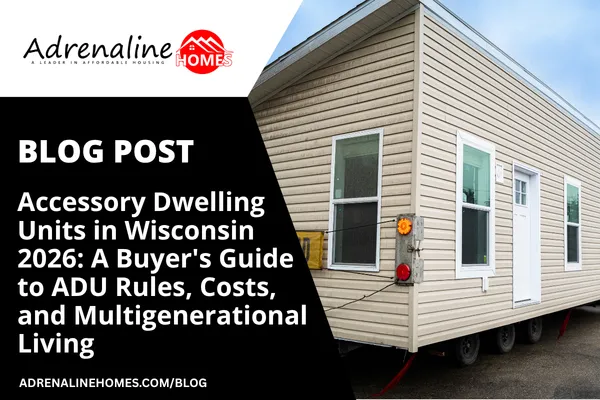
Accessory Dwelling Units in Wisconsin 2026: A Buyer's Guide to ADU Rules, Costs, and Multigenerational Living
An accessory dwelling unit, often called an ADU, is a smaller secondary home that sits on the same lot as a primary single-family residence. In Wisconsin in 2026, ADU rules are set city by city because two statewide bills (AB365 and AB449) that would have required local governments to allow ADUs as of right failed to pass in March 2026. That means whether you can add an ADU to your Kenosha, Racine, or Milwaukee property still depends on your municipality's zoning code. Cities like Madison already permit ADUs on owner-occupied single-family lots, while many smaller Wisconsin communities have not yet updated their codes. At the same time, new federal HUD, Fannie Mae, and USDA changes in 2025 and 2026 are making it easier to build and finance ADUs, especially factory-built ones like Adrenaline Homes' In-Law model. Here is what Wisconsin homeowners should know before starting.
What Is an Accessory Dwelling Unit, Exactly?
An accessory dwelling unit is a self-contained living space that includes its own kitchen, bathroom, and sleeping area on the same property as a primary home. The defining feature is that an ADU can function as an independent residence even though it is legally a secondary structure tied to the main house.
ADUs come in several common forms:
Detached ADUs: a separate structure, sometimes called a backyard cottage, guest house, or granny flat.
Attached ADUs: a separate unit physically attached to the main home, often as a wing or addition with its own entrance.
Interior or basement ADUs: a fully separate living space carved out of the main home, such as a finished basement apartment or upper-floor unit.
Garage conversion ADUs: a former garage rebuilt as conditioned living space.
Wisconsin homeowners typically consider ADUs for three reasons: housing an aging parent or adult child, generating rental income, or hosting long-term guests without giving up space in the main home. Each of those uses comes with different zoning, financing, and design considerations, but the underlying structure is the same.
Where Wisconsin Stands on Statewide ADU Rules in 2026
During the 2025-2026 session, two Wisconsin Assembly bills tried to standardize ADU rules statewide. AB365, introduced in July 2025, would have required every Wisconsin municipality with zoning to allow at least one ADU on any parcel that permitted single-family or multi-family use. It also banned cities from charging extra fees beyond standard permits, prohibited additional parking requirements tied to ADUs, and voided HOA covenants that blocked ADU use.
AB449, introduced in September 2025, was narrower. It would have required municipalities to allow one ADU on residential parcels with an existing single-family home, but preserved local authority to cap ADU size to the main house, limit height to the underlying zoning district, enforce setbacks and lot coverage, and prohibit new ADUs from being used as short-term rentals.
Both bills failed to pass on March 23, 2026, under Senate Joint Resolution 1. That outcome leaves Wisconsin without a uniform statewide ADU framework, so the rules that matter are whatever your local zoning ordinance says today.
How ADU Rules Currently Work in Wisconsin Cities
Because Wisconsin has no statewide ADU mandate, you need to check the specific municipality where the property sits. The rules vary widely. Madison is the most permissive example among major Wisconsin cities.
In Madison, ADUs are a permitted use on owner-occupied single-family lots, on duplex lots, and on parcels with buildings of up to eight dwelling units. Detached ADUs cannot exceed 25 feet in height, attached ADUs can be up to 1,000 square feet of living area, and either the main home or the ADU must be owner-occupied. Madison also charges a Parks Impact fee that runs about $4,500 in addition to standard building, water, sewer, and electrical permit fees.
Outside Madison, your situation depends on your local code. Some Wisconsin communities allow ADUs only as a conditional use, meaning a public hearing and discretionary approval. Others have no ADU provisions at all, which can make permitting slow. Before you commit to any ADU plan in Kenosha, Racine, or Milwaukee, pull your municipality's zoning code or call the planning department directly.
If you own land in an area where ADUs are not permitted today, your options usually include applying for a variance, attending a planning commission meeting to advocate for code changes, or choosing a property in a more ADU-friendly community.
The Federal Side: HUD, Fannie Mae, and USDA ADU Changes
While Wisconsin's statewide effort stalled, federal agencies have been actively expanding what ADUs can look like and how they can be financed. Three changes are worth knowing about in 2026.
HUD Code now allows up to four dwelling units
On September 15, 2025, the 4th and 5th Sets of the Manufactured Home Construction and Safety Standards took effect. These were the most extensive updates to the HUD Code in more than 30 years, and one of the most relevant changes for ADU buyers is that a single-family manufactured home can now contain up to four dwelling units. That opens the door to factory-built duplexes, triplexes, and fourplexes that could serve as an ADU plus rental units on a single lot, depending on local zoning.
Fannie Mae expanded ADU and manufactured home eligibility
In December 2025, Fannie Mae expanded property eligibility for both manufactured homes and ADUs. Under the updated guidelines, an ADU's construction method can be site-built or factory-built, including modular and HUD Code manufactured homes that are legally classified as real property. That matters because a factory-built ADU like Adrenaline Homes' In-Law can be financed through conventional Fannie Mae products when properly titled.
USDA proposed ADU financing for rural Wisconsin properties
On March 31, 2026, the USDA Rural Housing Service published a proposed rule that would let the Single Family Housing Guaranteed Loan Program finance properties with one or more income-producing ADUs. The public comment window closed June 1, 2026. If finalized, the rule could let rural Wisconsin USDA borrowers fund an ADU through the same loan rather than a separate construction or equity loan.
What an ADU Costs in 2026 (And Why Prefab Wins on Speed and Price)
ADU costs vary widely based on size, type, and build method. National averages for 2026 put the typical ADU at around $180,000, with most projects landing somewhere between $40,000 and $360,000. Cost per square foot generally runs between $150 and $300 for standard builds, though complex projects in expensive markets can exceed $600 per square foot.
Costs vary by ADU type:
Garage conversions: typically $80,000 to $150,000.
Attached ADUs: typically $150,000 to $300,000, since you need foundation work but can usually tap existing utilities.
Detached site-built ADUs: typically $181,000 to $350,000 due to full site preparation.
Modular or factory-built ADUs: typically $120,000 to $180,000, with 10 to 25 percent savings versus comparable site-built construction.
Speed is the other big variable. A factory-built ADU can be ready in 8 to 12 weeks once the site is prepared, while a comparable site-built ADU typically takes 7 to 15 months from permit to certificate of occupancy. For Wisconsin families navigating an aging parent's housing transition or a tight rental market, that difference often matters as much as the price tag.
Permits and impact fees add roughly $5,000 to $15,000 on top of the build cost in most markets, though the exact figure depends on the municipality. Plan for separate water, sewer, and electrical permits in addition to the main building permit.
When an ADU Makes Sense for Wisconsin Families
ADUs are not a universal fit. They work best for specific household situations where the alternatives are more expensive, slower, or less flexible.
Multigenerational living and aging in place
Roughly one in four U.S. adults lives in a multigenerational household, and ADUs give those families a way to share a property without sharing every wall. An adult child who needs help with rent, a parent who wants to be close but maintain independence, or a relative recovering from surgery can all live in a separate ADU on the same property. Adrenaline Homes' In-Law model was designed exactly for this use case at 540 square feet, which fits comfortably on most Wisconsin residential lots that allow ADUs.
Long-term rental income
An ADU rented to a long-term tenant can generate steady monthly cash flow and help offset the original mortgage on the primary home. With Fannie Mae's expanded ADU eligibility, lenders are now more willing to count projected ADU rental income toward qualifying for a refinance or new mortgage, though the exact treatment varies by program.
Workspace and home-based business
An ADU can also serve as a dedicated home office, workshop, or studio. For Wisconsin homeowners running consulting practices, photography studios, or trades businesses, an ADU keeps work life separate from the main household without paying for commercial real estate.
When an ADU is probably not the right call
If your lot is too small for setbacks, if your municipality does not permit ADUs, if your septic situation is difficult, or if your budget cannot absorb $120,000 or more in new debt, a different solution may fit better. That might mean upsizing the primary home, finishing a basement (which is not legally an ADU but still adds livable area), or buying a duplex outright.
Action Steps for Wisconsin Homeowners Considering an ADU
Pull your municipality's zoning code or call the planning department to confirm whether ADUs are permitted on your parcel, and under what conditions.
Map your lot to confirm you have enough usable space after setbacks, easements, and lot coverage limits.
Verify utilities. Check whether your water, sewer, and electrical service can support an additional dwelling, and budget for upgrades if not.
Decide between site-built and factory-built construction. Compare total cost, build time, design flexibility, and how each option will be appraised and financed.
Talk to a lender about Fannie Mae, FHA, and (in rural areas) USDA options for financing an ADU, and confirm titling requirements.
Tour a model. Walking through an ADU at full scale, especially in a virtual showroom, is the fastest way to know whether the layout works for your family before you commit.
Frequently Asked Questions
Are ADUs legal everywhere in Wisconsin in 2026?
No. Wisconsin does not have a statewide law requiring municipalities to allow ADUs. The two 2025-2026 bills (AB365 and AB449) that would have created one failed to pass in March 2026. Whether an ADU is allowed depends on your specific city, town, or village zoning code.
Can a manufactured home be used as an ADU in Wisconsin?
Yes, if your local zoning permits it and the home is titled as real property on a permanent foundation. As of December 2025, Fannie Mae specifically recognizes factory-built and HUD Code manufactured homes as eligible ADU construction methods, which makes them easier to finance through conventional mortgage products.
How much does an ADU cost to build in Wisconsin?
Expect $120,000 to $300,000 for most projects, depending on size and build method. Factory-built and modular ADUs typically land in the $120,000 to $180,000 range, while detached site-built units run $181,000 to $350,000. Permits, impact fees, and utility connections add roughly $5,000 to $15,000 on top of construction costs.
How long does it take to add an ADU?
A factory-built ADU can be ready in 8 to 12 weeks once the site is prepared and permits are issued. A comparable site-built ADU typically takes 7 to 15 months. Site preparation, foundation work, and utility hookups can add weeks or months on either path.
Can I rent out my ADU as an Airbnb or short-term rental?
It depends on your municipality. Many Wisconsin cities restrict or prohibit short-term rentals in ADUs, and AB449 specifically would have allowed local governments to ban short-term ADU rentals if it had passed. Always check your local short-term rental ordinance before planning to use an ADU this way.
Does an ADU add to my property value?
Generally yes, especially when the ADU is permitted, properly titled, and rentable. Appraisers will weigh the added livable square footage, rental income potential, and quality of construction. The exact value added varies by market, so ask a local appraiser or real estate agent familiar with ADU-comparable sales in your area.
Do I need owner-occupancy to add an ADU in Wisconsin?
It depends on the city. Madison, for example, requires either the main home or the ADU to be owner-occupied. Other Wisconsin municipalities have different rules or none at all. Verify the occupancy requirements in your specific code before you build.
Explore an ADU Option at Our Kenosha Showroom
If you are weighing an ADU for an aging parent, a returning adult child, or rental income, the fastest way to know whether the layout works for your family is to walk through one at full scale. Our In-Law model is a 540 square foot ADU designed for exactly this use, and you can preview it in our walkable floor plans system or in virtual reality before you commit. Browse all models to see how Tesla, Aberdeen, Meadow View, The Royale, Lexington, and Skyliner fit alongside an ADU on a single lot. Schedule a no-obligation consultation with our team to talk through zoning, financing, and timing for your Kenosha, Racine, or Milwaukee property.