
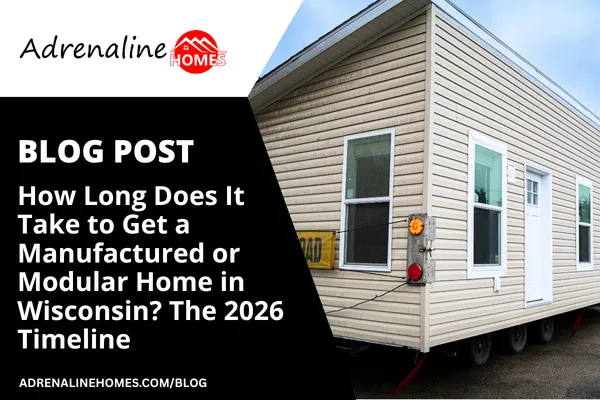
How Long Does It Take to Get a Manufactured or Modular Home in Wisconsin? The 2026 Timeline
Most Wisconsin buyers move into a new manufactured or modular home about four to seven months after signing their order. Factory construction runs four to twelve weeks depending on whether the home is HUD code or modular. County permitting takes roughly six to nine weeks and can overlap with the build. Site work adds three to five weeks, and delivery, set, and final inspection take one to four weeks more. Compare that to eight to fourteen months for a site-built house and the appeal is obvious. The timeline stretches when land needs utilities, when winter interrupts excavation, or when custom options push a factory slot back.
The Wisconsin Timeline at a Glance
Every build is different, but the sequence rarely changes. Here is the realistic range for a home going onto private land in Kenosha, Racine, or Milwaukee County in 2026.
Model selection and order: two to six weeks. Permitting and approvals: six to nine weeks, usually overlapping with the factory. Factory construction: four to eight weeks for a HUD code manufactured home, six to twelve weeks for a modular home. Site preparation and foundation: three to five weeks. Delivery and set: one to two days for transport, then three days to two weeks for the set itself. Final utilities, finish work, and inspection: one to three weeks.
Add those together and a straightforward manufactured home on a prepared lot can land near the four month mark. A modular home on a full basement, on raw land that needs a well and septic, is more likely to run six to nine months. Neither number is a promise, and any dealer who quotes you a hard date before seeing your site is guessing.
Stage One: Choosing Your Model and Signing the Order
This stage is entirely under your control, and it is where most buyers lose the most time. Comparing floor plans on a screen is slow work because dimensions on paper do not tell you how a kitchen actually feels. That is the reason we built the walkable floor plan projection and the VR tour system into our Kenosha showroom: buyers who physically step through a layout tend to decide in one or two visits instead of six.
Size drives everything downstream. A single section home like the Tesla at roughly 1,012 square feet moves through the factory and onto a foundation faster than a multi section plan. The In-Law at 540 square feet, our accessory dwelling unit option, is the quickest of all. A larger plan such as The Royale at 1,805 square feet involves more factory hours, a second transport, and a longer set. The Aberdeen, Meadow View, Lexington, and Skyliner plans all sit between those poles.
Two to six weeks is typical here, and the buyers who finish fastest are the ones who arrive with financing pre-approved and a clear budget ceiling.
Stage Two: Permitting and Approvals
Permitting in southeast Wisconsin runs about six to nine weeks, though it varies by municipality. Kenosha County, Racine County, and Milwaukee County each have their own review queues, and townships within them may add zoning review on top of the building permit.
Wisconsin also requires that the person setting your home hold a state license. Under SPS 305.327, no one may install a manufactured home onto a foundation or support system without a manufactured home installer license issued by the department, a rule in effect since January 1, 2007. An owner who will live in the home may install it themselves, but that exemption disappears the moment they contract the work out. Practically speaking, this means your installer is a scheduled resource, not an on-demand one, and their calendar can become the constraint in a busy summer.
The good news is that permitting almost always runs parallel to factory construction. If your dealer submits promptly after the order is signed, those six to nine weeks cost you very little calendar time.
Stage Three: Factory Construction
Here is where factory building earns its reputation. A HUD code manufactured home typically takes four to eight weeks of core assembly on the production line. A modular home, which is built to Wisconsin state code rather than the federal HUD code, generally takes six to twelve weeks depending on complexity and size. If you are still weighing which path fits, our breakdown of manufactured vs modular construction covers the code and financing differences in detail.
Two things stretch this window. Custom features can add weeks or, in some cases, months, because non-standard cabinetry, windows, and finishes have to be sourced outside the normal supply run. Manufacturer backlog is the other. Order in February and you are competing with fewer buyers than if you order in May, when the spring rush fills every production slot in the Midwest.
The advantage over site-built construction is that none of this depends on the weather. Snow, rain, and January cold that would shut down an outdoor framing crew have no effect on a climate-controlled production line.
Stage Four: Site Preparation and Wisconsin's Frost Rule
This is the stage most buyers underestimate, and in Wisconsin it carries real code weight. Under SPS 321.16, footings and foundations, including those for landings and stoops, must be placed below the frost penetration level or at least 48 inches below adjacent grade, whichever is deeper. That 48 inch minimum is among the most demanding in the country, and it is not negotiable.
Ground anchors carry their own requirement. Wisconsin code calls for anchor augers to be installed to the design depth of the anchor and not less than 30 inches, unless the foundation system is frost-protected against heave in frost-susceptible soil. Frost-protected shallow foundations built to ASCE 32 are permitted as an alternative to conventional footings, which can be worth discussing with your engineer if excavation depth is a cost concern on your lot.
Budget three to five weeks for site work on a lot that already has utilities at the road. If you need to prepare your land from scratch with a well, a septic system, or a long driveway, add time and get those quotes early. Concrete also needs curing time in dry conditions, which is why the foundation should be scheduled well ahead of the delivery date rather than squeezed in beside it.
Stage Five: Delivery, Set, and Final Inspection
Transport itself is fast. Delivery usually takes one to two days. The set is where the range widens: a single section home going onto a simple foundation can be complete in three days, while a multi section home on a basement can take up to two weeks once craning, marriage line work, roof closure, and siding are finished.
After the set comes the part that does not photograph well but decides your move-in date. Utility connections, HVAC startup, skirting or foundation enclosure, final grading, and the municipal inspection generally add one to three weeks. Schedule the inspection early rather than calling for it the day the last box is unpacked.
Total from delivery truck to keys in hand: typically one to four weeks.
How Season Changes the Wisconsin Timeline
Summer and early fall are the most predictable stretch for site work in southeast Wisconsin. Ground is dry, concrete cures on schedule, and crews are not fighting daylight.
Winter is not a dead zone, though. Frozen ground can actually improve stability for equipment and for the set itself, and factory production continues regardless of the forecast. What winter costs you is excavation and concrete: digging to 48 inches through frost is slower and more expensive, and cold-weather concrete requires blankets, admixtures, or heated enclosures.
The practical move for a spring move-in is to sign in the fall, permit through the winter, and have the foundation ready the moment the ground opens up. Buyers who wait until April to start are competing for the same crews, the same installers, and the same factory slots as everyone else in the region.
What 2026 Policy Changes Could Mean for You
Two federal developments are worth watching, though neither should change your planning today.
HUD published a proposed rule on June 12, 2026 that would revise the definition of a manufactured home by removing the permanent chassis requirement from the upper stories of multi-story units, leaving the requirement only on the ground-level section. HUD estimates structural savings of roughly $4,700 to $6,600 per multi-story unit. The public comment period runs through August 11, 2026, and the rule is still in review, so it is not final or legally in effect.
On the financing side, Freddie Mac lowered the minimum above-grade finished area for manufactured homes from 600 square feet to 400 square feet and, working with Fannie Mae under FHFA guidance, aligned the CHOICEHome and MH Advantage program specifications. Freddie also extended the maximum term on manufactured housing cashout refinances from 20 to 30 years. If you are comparing loan products, our guide to manufactured home financing in Wisconsin walks through what actually qualifies.
Why this matters for your timeline: financing approval is the single most common cause of delay we see, and aligned program specs mean fewer surprises during underwriting.
Action Steps to Keep Your Build on Schedule
1. Get pre-approved before you shop. Financing delays cost more calendar time than any other factor, and a pre-approval also tells you which models are realistically in range.
2. Confirm zoning on your parcel first. Local land-use rules vary by township, and finding out your lot will not accommodate the plan you love is an expensive way to lose a month.
3. Order utility and site quotes early. Well, septic, driveway, and electrical service quotes take longer to gather than most buyers expect.
4. Lock your finish selections at signing. Every change order after the factory slot is assigned risks pushing your home to the back of the line.
5. Book your licensed installer as soon as the order is placed. Summer calendars fill quickly across Kenosha, Racine, and Milwaukee counties.
6. Schedule the final inspection before the work is finished, not after. Inspector availability is a real queue.
7. If you want a spring move-in, sign in the fall. Permitting through winter is free calendar time.
Frequently Asked Questions
How long does it take to build a manufactured home in Wisconsin?
Factory construction of a HUD code manufactured home typically takes four to eight weeks. Adding permitting, site preparation, delivery, set, and final inspection, most Wisconsin buyers are looking at four to seven months total from signed order to move-in.
Is a modular home slower to build than a manufactured home?
Usually, yes. Modular homes generally take six to twelve weeks in the factory versus four to eight weeks for HUD code homes, and they are more often set on a basement or crawlspace, which lengthens the foundation and set stages. The tradeoff is that modular homes are built to Wisconsin state code and are financed as conventional real property from the start.
Can a manufactured home be delivered and set in winter in Wisconsin?
Yes. Factory production is unaffected by weather, and frozen ground can improve stability during the set. The winter constraints are excavation to the required 48 inch frost depth and concrete curing, both of which take longer and cost more in cold conditions.
How deep does a foundation have to be for a manufactured home in Wisconsin?
Wisconsin code requires footings and foundations to be placed below the frost penetration level or at least 48 inches below adjacent grade, whichever is deeper. Ground anchors must reach the anchor design depth and not less than 30 inches unless the system is frost-protected. Frost-protected shallow foundations built to ASCE 32 are an approved alternative.
Do I need a licensed installer to set my home in Wisconsin?
Yes, in almost every case. Wisconsin requires a state-issued manufactured home installer license to install a home onto a foundation or support system. The only exception is an owner installing a home they will personally live in, and that exemption does not apply if the owner contracts the work out.
What causes the biggest delays in a Wisconsin home build?
In order: financing approval, utility and site work on raw land, change orders after the factory slot is assigned, and inspector or installer scheduling during the summer peak. Weather is a factor, but it is rarely the largest one.
How much faster is this than building a site-built house?
Considerably. Traditional stick-built homes generally take eight to fourteen months to complete. A factory-built home on a prepared lot commonly finishes in four to seven months because the factory build and the site work happen at the same time rather than in sequence.
Ready to Talk Through Your Timeline?
Timelines get a lot more concrete once someone has actually looked at your lot and your plan. Our team walks through zoning, utilities, foundation type, and realistic delivery windows before you commit to anything.
Browse all models to see what fits your budget and your parcel, then schedule a no-obligation consultation with our team. Better yet, visit our Kenosha showroom and walk a full-scale projection of the floor plan you are considering. Seeing a layout at true size answers questions that no brochure can. We serve buyers throughout Kenosha, Racine, and Milwaukee counties.