
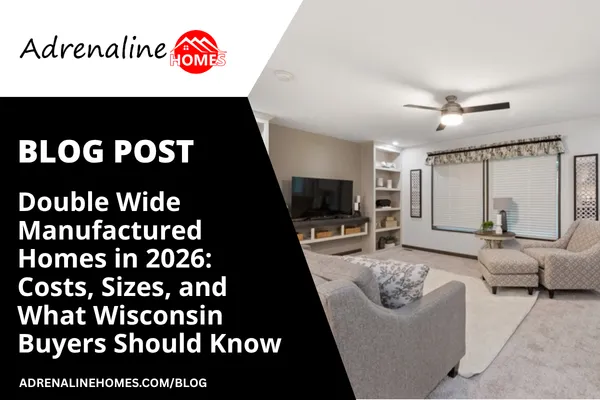
Double Wide Manufactured Homes in 2026: Costs, Sizes, and What Wisconsin Buyers Should Know
A double wide manufactured home is a factory-built home delivered in two sections and joined together on site, typically 24 to 32 feet wide with 1,000 to 2,400 square feet of living space. In 2026, a new double wide costs roughly $120,000 to $200,000 for the home itself, and recent industry data puts the national average near $161,200. All-in costs with land, site work, and a foundation in southeast Wisconsin usually land between $180,000 and $300,000, well below the roughly $273,000 average home value in Kenosha. Double wides qualify for FHA, VA, USDA, and conventional financing when set on a permanent foundation, and a major federal housing law that took effect on July 11, 2026 is expected to lower production costs further. This guide covers sizes, prices, financing, and what the new rules mean for Wisconsin buyers.
What Is a Double Wide Manufactured Home?
A double wide is a manufactured home built in a factory as two separate sections, transported to your property, and joined together on a foundation. Every double wide is constructed to the federal HUD code, the national building standard that governs design, structural strength, energy efficiency, and fire safety for manufactured housing. Once the two halves are set and sealed, the finished home is typically 24 to 32 feet wide and 40 to 76 feet long.
That extra width changes the living experience. Where a single-section home runs long and narrow, a double wide supports the layouts most buyers picture when they think of a traditional house: an open-concept kitchen and living area, a kitchen island, three or four bedrooms, two full bathrooms, and hallways that do not run the length of the home. Plans like The Royale, an 1,805 square foot multi-section home, show how far factory-built design has come, with a spacious great room and a primary suite that rivals site-built homes.
One clarification before we go further: a double wide is a manufactured home, not a modular home. Both are built in a factory, but modular homes are constructed to state and local building codes rather than the HUD code, and they are priced differently. If you are weighing both options, our guide to how much a modular home costs in Wisconsin covers that side of the decision.
How Much Does a Double Wide Cost in 2026?
Plan on $120,000 to $200,000 or more for the home itself, depending on size, features, and manufacturer. Industry sales data from late 2025 put the national average for a new double wide at about $161,200. Base pricing generally breaks down by size like this:
1,000 to 1,200 square feet: roughly $80,000 to $110,000
1,200 to 1,500 square feet: roughly $100,000 to $140,000
1,500 to 1,800 square feet: roughly $130,000 to $170,000
1,800 to 2,200 square feet: roughly $160,000 to $220,000
The base price is only part of the budget. Land (if you do not already own it), site preparation, the foundation, transport, utility hookups, and permits routinely add $25,000 to $50,000. Most southeast Wisconsin buyers should plan for an all-in cost between $180,000 and $300,000 once everything is included. Before committing to a parcel, learn what it takes to prepare your land for a manufactured home, since soil conditions, septic requirements, and driveway access all affect the final number.
For context, the average home value in the city of Kenosha is around $273,000 in 2026, and Kenosha County sits near $323,600. A well-equipped double wide on owned land can deliver comparable square footage for meaningfully less money.
Double Wide vs Single Wide: Which One Fits Your Plans?
Single-section homes typically measure 14 to 18 feet wide and offer roughly 600 to 1,300 square feet. They cost less upfront, with new single wides generally running $55,000 to $95,000 before site costs, and they suit narrow lots and tighter budgets. Double wides pull ahead on three fronts that matter over the long haul:
Layout. Two joined sections allow room separation, real hallways, larger kitchens, and true primary suites instead of one long corridor of rooms.
Financing. Most lenders prefer at least 1,000 square feet for 30-year manufactured home mortgages, a bar nearly every double wide clears and many single wides miss. That opens the door to FHA, VA, USDA, and conventional programs with lower rates and longer terms.
Resale. Double wides on permanent foundations in established areas hold value better than single wides and can function much like site-built homes in the resale market.
If a compact footprint is the goal, you still have strong options. The Tesla, at roughly 1,012 square feet, is an efficient plan right around that financing threshold, and The In-Law, a 540 square foot accessory dwelling unit, works well for multigenerational living on an existing property.
The New Federal Law That Changes the Math for Double Wide Buyers
On July 11, 2026, the 21st Century ROAD to Housing Act became law. It is widely described as the most significant federal housing legislation in decades, and it arrived with rare bipartisan support: the Senate passed it 85 to 5 and the House 358 to 32 in late June, and it became law automatically after the constitutional signing window expired. Several provisions matter directly to manufactured home buyers:
It eliminates the permanent chassis requirement for manufactured homes. Housing policy experts estimate this could trim $5,000 to $10,000 from construction costs and make designs with a second story or a basement easier to build.
It raises the loan limits on FHA-insured manufactured housing loans, giving buyers more room to finance larger multi-section homes.
It adds accessory dwelling unit construction as an eligible use for FHA property improvement loans, which helps buyers considering an ADU on family land.
It makes HUD the primary authority on energy efficiency standards for manufactured homes, which should bring more predictable efficiency rules over time.
Separately, HUD published a proposed rule on June 12, 2026 that would update the definition of a manufactured home so upper floor sections can be built and transported without a permanent chassis. HUD estimates that change alone could save buyers roughly $4,700 to $6,600 per home, and public comments are open through August 11, 2026.
One realistic caveat: these savings will take time to reach dealer lots. Homes available today were built under current standards, and manufacturers will phase in new designs as the rules are finalized. For the backstory on this year's regulatory shift, see our earlier post on the federal rule changes every Wisconsin buyer should know.
Financing a Double Wide in Wisconsin
A double wide on a permanent foundation and owned land qualifies for the widest range of loan programs available to factory-built housing. FHA Title II loans treat the home as real property, VA and USDA loans serve eligible buyers in many parts of Kenosha, Racine, and Milwaukee counties, and conventional options like Fannie Mae's MH Advantage program offer down payments as low as 3 percent with rates close to site-built mortgages.
If your home will sit in a land-lease community, chattel financing is the common route, with shorter terms and somewhat higher rates. Either way, the size of a double wide works in your favor, since crossing the 1,000 square foot mark keeps more loan products on the table. For a full walkthrough of loan types, credit requirements, and converting your home to real property, read our complete guide to manufactured home financing in Wisconsin.
Why Southeast Wisconsin Is a Strong Market for Double Wides
Kenosha remains one of the hottest housing markets in the Midwest in 2026. Local homes draw about three times the national average of online views and sell in roughly 36 days, compared with a 64-day national average, and values are up close to 6 percent year over year across the county. That is great news for owners and tough news for buyers shopping on a budget.
That squeeze is exactly why more families are turning to factory-built housing, a trend we covered in our post on why more Kenosha buyers are choosing manufactured homes. A double wide delivers the three-bedroom, two-bath footprint a growing family needs at a price the local site-built market cannot match, and the buying process moves faster.
At Adrenaline Homes, you can compare double wide layouts side by side before you commit. Our Kenosha showroom projects walkable floor plans at full scale so you can step inside a layout and feel the room sizes, and VR tours let you walk through homes from every angle. Popular floor plans like Meadow View, Aberdeen, Lexington, and the Skyliner series each strike a different balance of space and budget, and our team can point you to the double wide options that fit your land and loan program.
Action Steps for Wisconsin Double Wide Buyers
Ready to get serious? Work through these steps in order:
Set an all-in budget. Include the home, land or lot rent, site preparation, foundation, delivery, utility hookups, and skirting, not just the sticker price.
Get pre-approved early. Talk with a lender who knows manufactured housing so you understand whether FHA, VA, USDA, conventional, or chattel financing fits your situation.
Choose your land path. Buying acreage, using family land, and leasing in a community each change the budget and the loan options.
Walk the layouts before you decide. Full-scale floor plan projections and VR tours make it easy to compare double wide plans honestly.
Time your purchase around the new rules. If you are 12 to 24 months out, the chassis changes may expand your design options. If you are buying now, current inventory is built to proven standards.
Line up site work early. Foundation, well, and septic contractors book out quickly during southeast Wisconsin's busy season.
Frequently Asked Questions About Double Wide Manufactured Homes
Is a double wide the same thing as a manufactured home?
A double wide is one type of manufactured home. All manufactured homes are built to the federal HUD code; a double wide simply means the home arrives in two sections that are joined on site, which roughly doubles the width of a single-section home.
How long does a double wide manufactured home last?
A well-maintained double wide built to modern HUD standards can last as long as a comparable site-built home. Longevity depends far more on foundation quality, moisture control, and routine upkeep than on the factory-built label.
Do double wide homes appreciate in value?
They can. Federal Housing Finance Agency data tracking 2000 through 2024 found manufactured homes appreciated 211.8 percent versus 212.6 percent for site-built homes, a negligible difference. Land ownership is the key variable, and double wides on permanent foundations hold value better than single wides.
Can I put a double wide on a basement in Wisconsin?
Yes. Multi-section homes are regularly set on basement and crawl space foundations in Wisconsin. A basement adds cost upfront but brings storage, mechanical space, and resale value, and the new federal law is expected to make basement-friendly designs even more common.
How wide is a double wide manufactured home?
Most double wides measure 24 to 32 feet wide in total, built from two sections of 12 to 16 feet each, with lengths running about 40 to 76 feet. That works out to roughly 1,000 to 2,400 square feet of living space.
How fast can I move into a double wide in Kenosha?
Faster than you might expect. Adrenaline Homes builds its process around getting buyers into a home in about 90 days once financing and site work are in motion. Browse our current listings to see homes that are available right now.
See Double Wide Floor Plans in Person at Our Kenosha Showroom
The fastest way to know whether a double wide fits your family is to stand inside the floor plan. Visit our Kenosha showroom to walk full-scale projections, take a VR tour, and compare pricing across manufacturers in one stop. You can browse all models online to shortlist your favorites, then schedule a no-obligation consultation with our team. We serve buyers across Kenosha, Racine, and Milwaukee counties, and we will help you run the numbers from base price to move-in day.